Friday, September 09, 2005

Life in prison without a trial
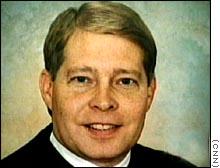
Michael LuttigIn July, a Federal Appeals Court heard arguments about Jose Padilla, the "dirty bomber" (except the government now admits that that was a false accusation), who has been held in prison for more than three years without a trial. As I wrote then, it was pretty obvious which way the case was going to go. Now the three-judge panel, let by extreme conservative Michael Luttig, has made its ruling:

U.S. Can Confine Citizens Without Charges, Court Rules
By Jerry Markon, Washington Post Staff Writer
Saturday, September 10, 2005

A federal appeals court yesterday backed the president's power to indefinitely detain a U.S. citizen captured on U.S. soil without any criminal charges, holding that such authority is vital during wartime to protect the nation from terrorist attacks.

The ruling, by the U.S. Court of Appeals for the 4th Circuit, came in the case of Jose Padilla, a former gang member and U.S. citizen arrested in Chicago in 2002 and a month later designated an "enemy combatant" by President Bush. The government contends that Padilla trained at al Qaeda camps and was planning to blow up apartment buildings in the United States. Padilla has been held without trial in a U.S. naval brig for more than three years, and his case has ignited a fierce battle over the balance between civil liberties and the government's power to fight terrorism since the Sept. 11, 2001, attacks. A host of civil liberties groups and former attorney general Janet Reno weighed in on Padilla's behalf, calling his detention illegal and arguing that the president does not have unchecked power to lock up U.S. citizens indefinitely.

Federal prosecutors asserted that Bush not only had the authority to detain Padilla but also that such power is essential to preventing terrorist strikes. In its ruling yesterday, the three-judge panel overturned a lower court.

A congressional resolution passed after Sept. 11 "provided the President all powers necessary and appropriate to protect American citizens from terrorist attacks," the decision said. "Those powers include the power to detain identified and committed enemies such as Padilla, who associated with al Qaeda . . . who took up arms against this Nation in its war against these enemies, and who entered the United States for the avowed purpose of further prosecuting that war by attacking American citizens."

Padilla is one of two U.S. citizens held as enemy combatants since the terrorist attacks on the World Trade Center and Pentagon. The other, Yaser Esam Hamdi, was released and flown to Saudi Arabia last year after the Supreme Court upheld the government's power to detain him but said he could challenge that detention in U.S. courts.
...

The ruling limits the president's power to detain Padilla to the duration of hostilities against al Qaeda, but the Bush administration has said that war could go on indefinitely.
...
Richard A. Samp, chief counsel for the Washington Legal Foundation, a conservative public-interest law firm, said the court "gave the government needed flexibility in dealing with the war on terrorism. You can't treat every terrorist as though they are just another criminal defendant."

But Avidan Cover, a senior associate at Human Rights First, said the ruling "really flies in the face of our understanding of what rights American citizens are entitled to." Opponents have warned that if not constrained by the courts, Padilla's detention could lead to the military being allowed to hold anyone who, for example, checks out what the government considers the wrong kind of reading materials from the library.
...
The government originally described Padilla as plotting with al Qaeda to detonate a radioactive "dirty bomb" but has since focused on allegations that he planned to blow up apartment buildings by filling them with natural gas. Prosecutors told the 4th Circuit that he worked with such senior al Qaeda leaders as former operations chief Khalid Sheik Mohammed on that plan.
Disgusting. Luttig is a judge who has no respect for the constition or the rule of law, or trials. He considers it a fact that Padilla has worked with Al Queda and taken up arms against the United States, despite the fact that the government has never formally accused Padilla of anything. Luttig has complete faith in the President's judgement and assumes if he has declared Padilla an enemy combatant, Padilla must be one. This although the President has repeatedly proved himself incompetent and untrustworthy. I make a different assumption. Given that the Justice Department has put other people on trial in civil courts as part of the "war on terror", it seems evident that they have an extremely weak case against Padilla.

Padilla may very well be innocent, and I will assume his innocence until proven otherwise in a court (unlike the New York Times). Consider the ramifications of Padilla's situation. Any of us could be held in prison for years, decades even, as long as the country is "at war".

Thursday, March 01, 2007

Jose Padilla: nondelusionally paranoid?

Dahlia Lithwick has a great article in Slate this week on the hearing to determine if Jose Padilla is mentally fit to stand trial. Here are a few paragraphs from the piece:
That's why it's worth keeping an eye on the proceedings this week in Miami as federal Judge Marcia Cooke tries to determine whether the alleged "dirty bomber"—scratch that—alleged "apartment bomber"—um, scratch that—alleged terror conspirator Jose Padilla is mentally fit to stand trial. What the prosecution now claims almost defies credulity. They contend that Padilla is wholly unharmed—after spending 1,307 days in a 9-foot-by-7-foot cell in a Navy brig in South Carolina, where he says he was, among other things, deprived of sleep, light, sight, sound, shackled in stress positions, injected with "truth serum," and isolated for extended stretches of time. It's better than that. According to the government, Padilla is faking his craziness.
The hearing is only to determine whether Padilla is fit to stand trial, not whether the abuse was grounds to dismiss the trial (that will come later).
So, what happened to Padilla in those many months of quasi-abusive solitary confinement is legally relevant only if the court determines that he is, right now, too damaged to understand the charges against him or aid in his defense. And not surprisingly, it has come down to a battle of the experts. As of today, two defense experts have testified that Padilla suffers from shattering post-traumatic stress disorder, facial tics, and Stockholm syndrome, which has him protecting the government and fearing his own attorneys. (He has been described by some prison staff as behaving like "a piece of furniture.")

The prosecution's expert, on the other hand, vows that Padilla's mental health problems are relatively minor and in no way impede his ability to stand trial. (So far my very favorite line from the various psychological evaluations of Padilla is this unironic note: "He does believe that he is being persecuted by the government, and he does demonstrate some paranoia about the government, but this does not appear to be delusional.") The prosecution's other claims range from laughable to horrifying: Padilla is alternately "malingering," faking so he doesn't have to stand trial; or his mental illness is a result of his own history of drug abuse; or he is clearly capable of assisting his lawyers, because he managed to tell them he'd been abused in confinement. Most unnervingly, they assert that the abuse he suffered—which they can't quite bring themselves to deny—is "irrelevant to the criminal case against him."

Saturday, August 18, 2007

one step away from a thought crime

How do you spin the conviction of Jose Padilla this week? Perhaps the President was justified in declaring Padilla an enemy combatant and waiving Habeas Corpus? Or was he not justified in ignoring the Constitution, because our legal system is strong enough to convict Padilla?

After reading the article below, it seems to me that the answer is that both the legal system and the President's extra-legal system are corrupt.


From The New York Times:Padilla Case Offers a New Model of Terror Trial
By ADAM LIPTAK
There were two perfectly predictable schools of thought being expressed after the conviction of Jose Padilla on Thursday on terrorism-related charges. Supporters of the Bush administration said the conviction justified the more than three years Mr. Padilla spent in military detention before his criminal prosecution, while the administration’s opponents said the verdict proved that the criminal justice system should have handled the case in the first place.

But the real innovation in Mr. Padilla’s case, some legal experts said yesterday, was more subtle than those dueling talking points suggested. The Justice Department’s strategy in the trial itself, using a seldom-tested conspiracy law and relatively thin evidence, cemented a new prosecutorial model in terrorism cases.

The central charge against Mr. Padilla was that he conspired to murder, maim and kidnap people in a foreign country. The charge is a serious one, and it can carry a life sentence. But prosecutors needed to prove very little by way of concrete conduct to obtain a conviction under the law.

“There is no need to show any particular violent crime,” said Robert M. Chesney, a law professor at Wake Forest University and the author of a recent law review article on conspiracy charges in terrorism prosecutions. “You don’t have to specify the particular means used to carry out the crime.”

Indeed, the strongest piece of evidence in Mr. Padilla’s case was what prosecutors said was an application form Mr. Padilla filled out to attend a training camp run by Al Qaeda in Afghanistan in 2000.

“It is a pretty big leap between a mere indication of desire to attend a camp and a crystallized desire to kill, maim and kidnap,” said Peter S. Margulies, a law professor at Roger Williams University who has also written on conspiracy charges in terrorism prosecutions.

The conspiracy charge against Mr. Padilla, Professor Margulies continued, “is highly amorphous, and it basically allows someone to be found guilty for something that is one step away from a thought crime.”


Prosecutors have long loved conspiracy charges in all kinds of cases. Judge Learned Hand, widely thought to be the greatest American judge never to sit on the Supreme Court, called conspiracy “that darling of the modern prosecutor’s nursery” in a classic 1925 decision. More recently, Judge Frank H. Easterbrook, now the chief judge of the federal appeals court in Chicago, lamented that “prosecutors seem to have conspiracy on their word processors as Count I.”

But recent terrorism prosecutions are doing more than using an old tool with new aggressiveness, legal experts said. They are also using it for a new purpose: preventive detention.

Before allowing Mr. Padilla to be tried in the federal courts, the administration justified holding him as an enemy combatant in part by saying he would be dangerous if let go. Criminal prosecutions, by contrast, are almost always focused on conduct already committed.

But the sharp split between military detention and criminal prosecution starts to blur as conspiracy charges are added to the mix.

That is because conspiracies aim at the future. A successful conspiracy prosecution looks both backward, to punish the crime of conspiring, and forward, to stop dangerous people from completing their plans. The weaker the evidence of conspiracy is, the more such a prosecution can look like a request for judicially sanctioned preventive detentions.

In opinion articles and academic commentary, lawyers and law professors across the political spectrum have been arguing in recent months about whether the criminal law should be supplemented by legislation authorizing preventive detention. The Padilla verdict suggests that something similar may have already been achieved in the courts.

There was a second justification for Mr. Padilla’s prolonged military detention. In a sworn statement in 2003, Vice Adm. Lowell E. Jacoby, then the director of the Defense Intelligence Agency, told a federal judge in New York that Mr. Padilla should be interrogated without access to a lawyer.

“It is critical to minimize external influences on the interrogation process,” Admiral Jacoby wrote. “Anything that threatens the perceived dependency and trust between the subject and interrogator directly threatens the value of interrogation as an intelligence-gathering tool.”

That sort of intensive and isolated interrogation, which Mr. Padilla lawyers have said caused him lasting psychiatric problems, could not have been accomplished in the criminal justice system, where the Constitution guarantees legal representation and other due process protections.

But Justice Sandra Day O’Connor, in her controlling opinion in Hamdi v. Rumsfeld, the 2004 Supreme Court decision that endorsed the detention of at least some enemy combatants to prevent their return to the battlefield, rejected interrogation as a rationale for detention.

That same year, the Supreme Court ruled on a procedural question in the Padilla case but did not discuss whether his detention was proper. Just before the Supreme Court was to decide whether to hear his case again, the administration moved him to the criminal justice system.

If Thursday’s verdict is upheld, the administration may thus have achieved the last in a series of practical victories. It held and interrogated Mr. Padilla without interference from the courts, and now it has convicted him of a crime that could put him away for life.

Wednesday, December 21, 2005

I don't get it

NY TIMES: Court Refuses U.S. Bid to Shift Terror Suspect
By NEIL A. LEWIS

WASHINGTON, Dec. 21 - A federal appeals court delivered a sharp rebuke to the Bush administration Wednesday, refusing to allow the transfer of Jose Padilla from military custody to civilian law enforcement authorities to face terrorism charges...

What made the action by the United States Court of Appeals for the Fourth Circuit in Richmond, Va., so startling, lawyers and others said, was that it came from a panel of judges who in September had provided the administration with a sweeping court victory, saying President Bush had the authority to detain Mr. Padilla, an American citizen, indefinitely without trial as an enemy combatant.

But the judges were clearly angered when the administration suddenly shifted course on Nov. 22, saying it no longer needed that authority because it now wanted to try Mr. Padilla in a civilian court. The move came just days before the government was to file legal papers in Mr. Padilla's appeal to the Supreme Court. The government said that as a result of the shift, the court no longer needed to take up the case. Many legal analysts speculated at the time that the administration's sudden change in approach was an effort to avoid Supreme Court review of the Fourth Circuit ruling.

In the opinion on Wednesday, written by Judge J. Michael Luttig, the court said the panel was denying permission to transfer Mr. Padilla as well as the government's suggestion that it vacate the September decision upholding Mr. Padilla's detention for more than three years in a military brig as an enemy combatant.

Judge Luttig, a strong conservative judicial voice who has been considered by Mr. Bush for the Supreme Court, said the panel would not agree to the government's requests because that would compound what was "at least an appearance that the government may be attempting to avoid consideration of our decision by the Supreme Court, and also because we believe that this case presents an issue of such especial national importance as to warrant final consideration by that court."

...

Prof. Carl W. Tobias of the University of Richmond Law School, who has written about the government's legal strategy in terrorist cases, said that the ruling on Wednesday was an extraordinary rebuff to the Bush administration by the judicial branch.

"It's obvious that the government thought that its motion to transfer Padilla would be perfunctory," Professor Tobias said. But administration lawyers had not counted on the possibility that the appeals court judges would feel ill used in expending their institutional capital in support of Mr. Bush's action only to have the government decide that it no longer wanted the authority that it had sought so strongly.

...

Ms. Scolinos said the department was considering what to do in light of the court's refusal to authorize the transfer of Mr. Padilla. The likely outcome of the appeals court panel's decision, some lawyers believed, was that the Supreme Court would be obliged to consider the case.

Jonathan M. Freiman, a lawyer for Mr. Padilla (pronounced puh-DILL-ah), said that the appeals court "seems to have agreed with what we asserted in our brief, that the government has been attempting to evade Supreme Court review."

Mr. Padilla ... was arrested at O'Hare International Airport on May 8, 2002. Government officials initially portrayed him as someone who was considering a plot to explode a radioactive "dirty bomb" in some American city and then to destroy gas lines to destroy public buildings.

In the criminal indictment issued by a grand jury in Florida, the government no longer asserted either of those charges and instead charged him with fighting against American forces alongside Al Qaeda soldiers in Afghanistan.

...

[Judge Luttig] said the government "must surely understand" that it has left the impression that Mr. Padilla may have been held for more than three years by mistake.
Maybe I misjudged Luttig, who when first hearing the Padilla case implied that this President ( the one who warned about Saddam's "nuclear mujahideen") should be allowed to do anything he wants. I thought he was a thug who didn't care about the civil liberties of potentially innocent people. But maybe Luttig just had the extraordinarily bad sense to trust this President (the one who said, "you're doing a heck of a job, Brownie") to be a good enough judge of character to only deem guilty people enemy combatants. Maybe Luttig realizes he made a mistake when he assumed this President wouldn't make those kind of mistakes.

Sunday, January 08, 2006

Jose Padilla reclaims his birthright

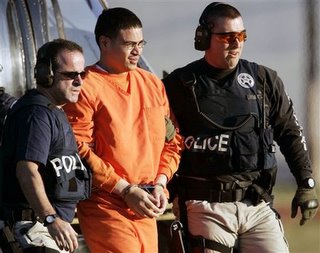
Jose PadillaJose Padilla, U.S. citizen, whom the president arbitrarily stripped of his constitutional rights, was finally in court this week. Magistrate Judge Barry Garber "explained Padilla's rights as a criminal defendant, asking him: Do you understand me so far?".

Tuesday, July 19, 2005

All the world's a battlefield...

Michael Luttig: Throw away the key

And all the men and women merely combatants...
Va. Appellate Panel Hears Arguments in Padilla Case By Tom Jackman

RICHMOND, July 19 -- A top government attorney declared Tuesday that, in the war on terror, the United States is a battlefield, and therefore President Bush has the authority to detain enemy combatants indefinitely in this country.

Solicitor General Paul D. Clement's comments came as a three-judge panel of the U.S. Court of Appeals for the 4th Circuit is considering whether to overturn a lower court ruling that Jose Padilla should be charged with a crime or released. In 2002, Padilla, a former Chicago gang member and Muslim convert, was taken into custody by the military and has been held without trial since...

The panel assigned to hear the arguments was Judge J. Michael Luttig of Alexandria, an appointee of President George H.W. Bush, and two appointees of President Bill Clinton: Judge M. Blane Michael of Charleston, W.Va., and Judge William B. Traxler Jr. of Greenville, S.C.

The judges were most concerned with how to handle Padilla in light of the U.S. Supreme Court's ruling last year on Yaser Esam Hamdi. Hamdi, also a U.S. citizen, was captured by the military with Taliban forces in Afghanistan and placed in a Navy brig in Norfolk. The Supreme Court ruled that his detention was lawful but that he was entitled to a hearing to challenge the allegations against him...

But Michael said Padilla wasn't captured anywhere near a battlefield. "You captured Padilla in a Manhattan jail cell," Michael said. "What, in the laws of war, allows you to undertake a non-battlefield capture and hold them for the duration? I don't think you cite anything."

Michael, addressing Clement's claim that the United States is a battlefield, then asked, "to call the United States a battlefield, wouldn't you have needed a specific authorization from Congress? It's not up to us as a court to develop laws of war."

Luttig posed a hypothetical in which the president learned that a terrorist was about to bomb a building in Manhattan. "Does he have to call a U.S. attorney and wait for the man to be picked up by civilian law enforcement? If the president sends the military, it's illegal?" Luttig asked.

"If the military picks him up, he must be surrendered to civilian authorities," Patel said.

"We might as well not have a president of the United States," Luttig said, "if his hands are tied behind his back to protect the citizens of the United States. . . . This is a failure to appreciate the real world circumstances that can confront a president of the United States."...

No date was set for when the panel might rule. The losing side could then ask that the entire 4th Circuit rehear the case, after which the case would probably head to the Supreme Court.

Here is a hypothetical for Judge Luttig: if you where pretty sure a man was going to blow up a building in Manhattan, would the president have the right to capture him and lock him up in solitary confinement for the rest of his life without access to a lawyer? Because what is the point of having a president if he can't have people disappeared, right?

Wednesday, February 21, 2007

From the slippery slope dept.

A federal appeals court agreed to strip allegedly foreign prisoners of their right to challenge their detention at Guantanamo Bay:
A divided federal appeals court on Tuesday upheld a new law stripping federal judges of authority to review [alleged] foreign prisoners’ challenges to their detention at Guantánamo Bay, Cuba...

That law, the Military Commissions Act of 2006, was signed by President Bush last October. Its enactment followed the Supreme Court’s rejection of his administration’s earlier arguments that the right of habeas corpus — the fundamental right, centuries old, to ask a judge for release from unjust imprisonment — did not apply to [alleged] foreigners being held outside the United States as enemy combatants.

The new law explicitly eliminated the federal courts’ jurisdiction over habeas challenges by such prisoners. It instead set up military panels to review the justification of detention in individual cases, with limited right of appeal to the courts afterward.
This blog will continue to uphold the principle of innocent until proven guilty, even if the three branches of the federal government do not. And I still think this opens the door to U.S. citizens being locked up in Gitmo. How do you prove you're a citizen if you can't dispute your detention in court? Paranoid? Just ask Jose Padilla.

L.A. angle? You could be next...